Vector search at storage prices
S3 is the source of truth. Nodes are stateless. Vector, full-text, and hybrid search.
Fully open source.
Install the Zeppelin skill for Claude Code.
Use our hosted instance to create namespaces, store and query data!
Just ask Claude to tell you more about this skill and try everything out.
curl -sL https://zepdb.github.io/install.sh | shS3-Native Storage
Object storage is the source of truth. Scales to petabytes.
Vector Search
IVF-Flat with SQ8, Product Quantization, and hierarchical ANN.
BM25 Full-Text
Inverted indexes with tokenization, stemming, and hybrid ranking.
Bitmap Pre-Filters
RoaringBitmap indexes for sub-ms attribute filtering.
Tunable Consistency
Strong or eventual reads. Choose per query.
Formally Verified
26 TLA+ specs prove WAL, compaction, and CAS correctness.
Performance at scale
1M vectors, 768d, cosine
zepdb/zeppelin-benchmarkPricing calculator
Zeppelin = S3 storage + compute. Configure your setup and compare.
SQ8 quantization, 20% index overhead, 730 hrs/mo compute
Up and running in 60 seconds
Start
docker run -p 3000:3000 \
  -e AWS_ACCESS_KEY_ID=your-key \
  -e AWS_SECRET_ACCESS_KEY=your-secret \
  -e ZEPPELIN_BUCKET=your-bucket \
  -e ZEPPELIN_REGION=us-east-1 \
ghcr.io/zepdb/zeppelin:latestCreate a namespace
curl -X POST http://localhost:3000/v1/namespaces \
  -H "Content-Type: application/json" \
  -d '{"dimensions": 768}'

# Response includes "name": "<uuid>" — save it!Upsert
curl -X POST http://localhost:3000/v1/namespaces/<namespace-uuid>/vectors \
  -H "Content-Type: application/json" \
  -d '{
    "vectors": [
      {
        "id": "vec-1",
        "values": [0.1, 0.2, 0.3, "..."],
        "attributes": {
          "category": "science",
          "year": 2024
        }
      }
    ]
}'Query
curl -X POST http://localhost:3000/v1/namespaces/<namespace-uuid>/query \
  -H "Content-Type: application/json" \
  -d '{
    "vector": [0.1, 0.2, 0.3, "..."],
    "top_k": 10,
    "filters": {
      "op": "And",
      "conditions": [
        {"op": "Eq", "field": "category", "value": "science"},
        {"op": "Gte", "field": "year", "value": 2020}
      ]
    },
    "include_attributes": true
  }'
Architecture
Stateless nodes. S3 is the single source of truth.
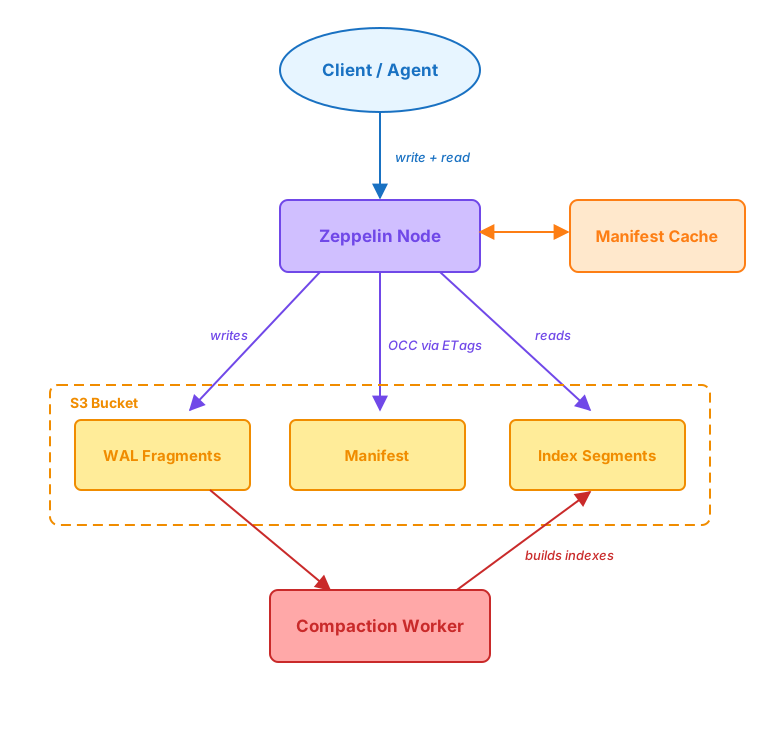
- Append-only WAL fragments to S3
- OCC via S3 ETags on central Manifest
- Monotonic fencing tokens prevent zombie writers
- Deterministic sequence numbers (no clock skew)
- Merges fresh WAL data + optimized segments
- Strong: parallel scan of WAL + indexed segments
- Eventual: fast-path over segments only
- Singleflight coalesces concurrent manifest fetches
- IVF-Flat / Hierarchical ANN with k-means + quantization
- BM25 inverted indexes for full-text search
- RoaringBitmap indexes for sub-ms attribute filtering
- Runs in background, never blocks writes
- Instant elasticity: stateless nodes, no resharding, 1→100 in seconds
- Zero-state recovery: no replication lag, Manifest is source of truth
- Storage economics: S3 rates vs. NVMe; scale compute independently
- Decoupled read/write: WAL available immediately; indexing is background
- S3 latency floor: baseline 20-50ms; caching helps but not sub-5ms
- Consistency lag: ManifestCache TTL ~500ms across nodes
- Compaction health: latency degrades if WAL fragments grow unchecked
- Cold-start: first queries populate LRU cache from S3
About

Your vectors belong in your object storage, not someone else's proprietary system. Search should cost what storage costs.
I've spent 14 years inside distributed storage systems: Sybase ASE internals in C/C++, Cisco WebEx, SAP HANA, then building Hyperforce at Salesforce. One lesson kept coming back.
In an agent-first future, agents won't care about latency the way web apps do. They'll care about cost and simplicity. If your vectors live in S3, you pay S3 prices. Nodes become stateless. You scale by adding buckets, not by babysitting clusters.
On February 10th, 2026, I started building Zeppelin at the Claude Code Hackathon. The seed fund was $500 in Claude credits. I directed the architecture. Every line of Rust was written by Claude Opus 4.6. One human, one AI, no team, no investors.
The result: 451 tests, 26 TLA+ specs, 1.2M+ states explored, and an engine released under Apache-2.0.
Zeppelin is open source because infrastructure should be. No vendor lock-in, no opaque pricing, no proprietary formats. Your data stays in your buckets.
Smarter architecture beats faster clusters.